In geometry, collinearity of a set of points is the property of their lying on a single line. A set of points with this property is said to be collinear. In greater generality, the term has been used for aligned objects, that is, things being "in a line" or "in a row". Source: Wikipedia
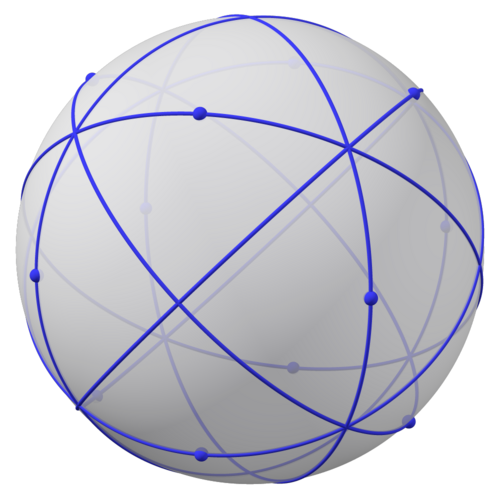
What are geodesics and why use them?
The two lines on this map demonstrate the difference between a geodesic and rhumb line (loxodrome).
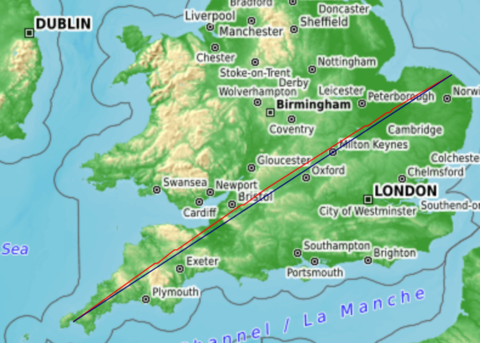
The red line represents the geodesic, which denotes the shortest distance between two points. In contrast, the blue line represents the rhumb line, which maintains a constant azimuth throughout its entire length. Unlike the rhumb line, a geodesic's azimuth varies continuously.
Both lines commence from St. Michael's Mount in Cornwall and terminate near Cromer in Norfolk. The maximum separation between the two lines is approximately 7 kilometers. The rhumb line measures 565.984 kilometers, while the geodesic distance is 565.778 kilometers; thus, the geodesic is 206 meters shorter than the rhumb line.
When a straight edge is drawn on a Mercator projection map, such as those commonly found on Ordnance Survey sheets or digital platforms like Google Maps and OpenStreetMap, it produces a rhumb line because meridians are depicted as parallel lines. Although this projection is convenient at low latitudes, it introduces significant distortion near the poles.
In reality, a rhumb line that appears straight on a Mercator map follows a curved trajectory; if extended indefinitely, it spirals toward a pole.
At least three points are required to define an alignment. A straight line connecting three or more points on a Mercator map does not represent the shortest route between them. The true shortest-path solution is the geodesic, which necessitates more complex mathematical calculations. For this project, both geodesics and rhumb lines were computed on an ellipsoid using Charles Karney's GeographicLib
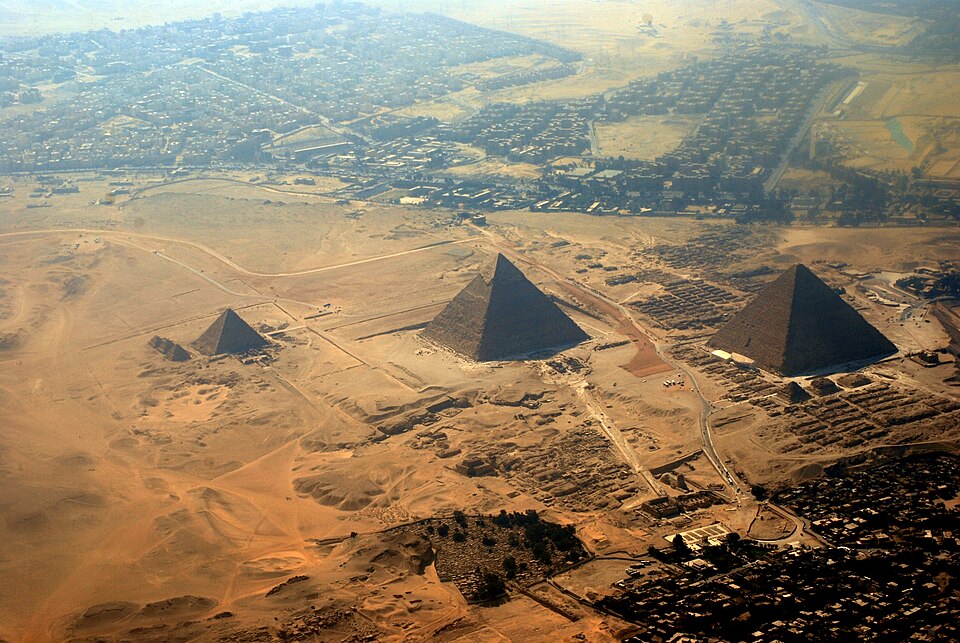
The Giza Plateau
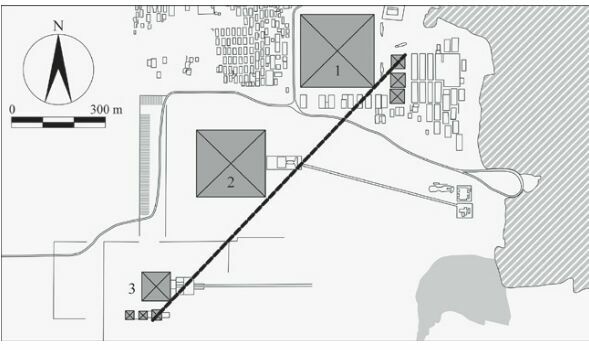
In this next example a line runs along the diagonal of Menkaura's pyramid, first queen's pyramid, the south- east corner of Menkaura's pyramid, the diagonal of his funerary temple, the south-east corner of the second pyramid court, the diagonal of the fore-temple, the south-east corner of Khufu's pyramid and the diagonal of Khufu's first queen's pyramid. Magli 2013
 Cleopatra's Needle, London
Credits
Cleopatra's Needle, London
Credits